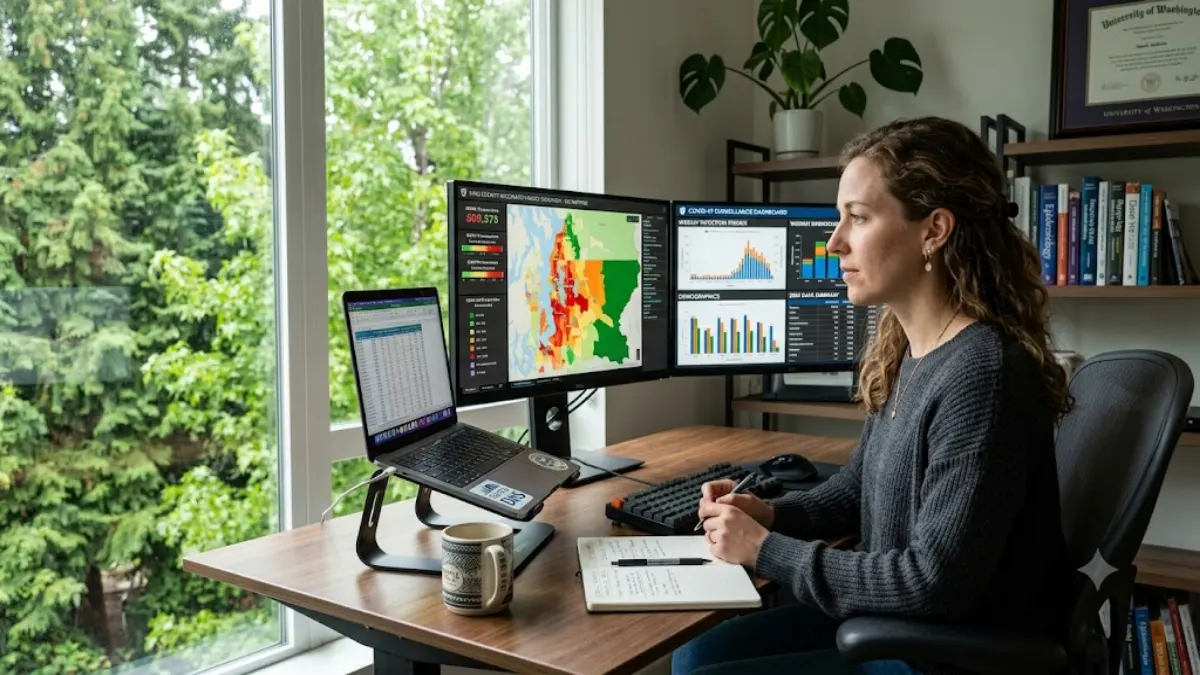
The morning sun barely hits the window frame when the slack notification pings. It’s 8:02 AM. Marcus sips his dark roast, comfortably seated in his home office in Austin, Texas. On screen, a real-time heat map of respiratory surveillance data lights up across three Midwestern counties. As a remote Senior Public Health Data Analyst for a national healthcare consulting firm, he doesn’t battle bumper-to-bumper city traffic or sprint through hospital corridors. His battleground is digital, his tools are Python and Tableau, and his mission impacts thousands of lives before lunch.
Marcus isn’t an anomaly. He’s part of a massive movement of professionals taking advantage of remote public health jobs to build lucrative, flexible careers that directly improve population health.
Whether you’re a seasoned biostatistician tired of the commute or a public health graduate eager to land your first remote role, the market has shifted dramatically. High-paying work-from-home roles in epidemiology, health policy, program management, and clinical research are multiplying. But landing these positions requires more than just submitting a generic resume to massive job boards. You need an insider edge to bypass corporate filters and present yourself as the clear choice.
Where the Real Remote Public Health Jobs Are Hiding

Most job seekers make a critical mistake: they type “public health” into standard search engines and scroll endlessly through thousands of mismatched corporate listings. To land top-tier remote public health jobs, you must target specialized pipelines that cater directly to government agencies, global non-profits, healthcare technology firms, and research institutions.
       [ SPECIALIZED PUBLIC HEALTH HIRING PIPELINES ]
                             │
     ┌───────────────────────┼───────────────────────┐
     ▼                       ▼                       ▼
 Government/Public       Health Tech/SaaS        Global Health/NGOs
  • USAJOBS (Telework)    • Digital Health Apps   • FHI 360 & Devex
  • CSTE Clearinghouse    • Epic & Cerner Consulting• PATH & WHO Projects
  • State Health Depts    • Health Informatics    • Philanthropic Grants
1. Government and State Health Portals
Federal, state, and county agencies represent the largest employer of public health talent in the United States.
- USAJOBS.gov: Set your location filter specifically to “Remote” or “Telework Eligible.” Key search terms include Series 0685 (Public Health Program Specialist), Series 0601 (General Health Science), and Series 0635 (Kinesiologist/Exercise Specialist).
- CSTE (Council of State and Territorial Epidemiologists): Their dedicated job clearinghouse frequently features remote surveillance, informatics, and epidemiology positions funded by federal grants.
- State Public Health Associations: Many state health departments outsource their data management, contact tracing oversight, and health equity reporting to full-time remote contractors.
2. Health Tech, SaaS, and Digital Health Startups
Private industry pays exceptionally well for public health expertise to train AI models, guide clinical software, and analyze population health outcomes.
- Health Informatics Platforms: Companies building electronic health record (EHR) tools, remote patient monitoring platforms, and tele-triage systems constantly recruit remote public health analysts.
- Payer and Insurance Networks: Giant health plans (such as UnitedHealth Group, Elevance Health, and Humana) employ remote public health professionals to oversee disease management and wellness initiatives.
3. Global Non-Profits and Research Institutes
If your passion leans toward global health, health policy, or maternal-child wellness, non-profit institutions frequently operate fully remote workforces across the U.S.
- Devex: The premier platform for global development and public health roles. Filter for “Remote – U.S. Base.”
- FHI 360, PATH, and John Snow, Inc. (JSI): These global public health organizations routinely recruit remote grant managers, monitoring and evaluation (M&E) specialists, and technical advisors.
High-Demand Roles and Salary Benchmarks
Not all remote public health jobs carry the same earning potential or day-to-day expectations. The table below breaks down the top remote career tracks based on verified U.S. labor statistics and hiring trends.
Remote Public Health Career Pathways & Salary Breakdown
| Job Title | Primary Responsibilities | Entry-Level Salary | Senior-Level Salary | Key Software & Skill Set |
| Remote Epidemiologist | Track disease patterns, design outbreak interventions, analyze longitudinal health datasets. | $68,000 – $78,000 | $115,000 – $138,000+ | R, SAS, Python, ArcGIS, Spatial Analysis |
| Public Health Data Analyst | Synthesize patient/population metrics, build executive dashboards, write grant reports. | $55,000 – $65,000 | $98,000 – $135,000+ | SQL, Tableau, Power BI, Advanced Excel |
| Health Policy Analyst | Evaluate healthcare legislation, compliance standards, and Medicaid/Medicare policy shifts. | $62,000 – $70,000 | $105,000 – $142,000+ | Policy Briefing, Legislative Research, Regulatory Analysis |
| Remote Clinical Research Associate (CRA) | Oversee remote clinical trials, audit trial site compliance, manage participant data integrity. | $72,000 – $85,000 | $120,000 – $155,000+ | EDC Systems (Veeva, Medidata), GCP Compliance, Clinical Auditing |
| Public Health Program Manager | Direct grant budgets, manage cross-functional teams, track community health benchmarks. | $65,000 – $75,000 | $110,000 – $140,000+ | Asana, Jira, Grant Writing, Budget Management |
Tailoring Your Resume to Pass the Corporate ATS Filter
Applying for remote public health jobs with a generic resume is like sending a message in a bottle. Large healthcare networks and government contractors receive hundreds of applications for every open remote role. They rely heavily on Applicant Tracking Systems (ATS) to screen candidates out before a recruiter ever looks at a document.
       [ ATS RESUME SCANNER FILTERS ]
                    │
   ┌────────────────┴────────────────┐
   ▼                                 ▼
 WEAK RESUME (REJECTED)           ATS-OPTIMIZED RESUME (PASSED)
 • Unformatted PDFs               • Clean single-column layout
 • Vague duty descriptions        • Action verbs + quantifiable metrics
 • Missing core software names    • Exact keyword matches (e.g., SAS, HIPAA)
 • Visual elements & tables       • Standard, scannable text headings
To guarantee your application reaches human eyes, run your draft through a high-precision ATS resume builder tool before hitting submit.
Here is a side-by-side comparison showing how to convert passive, weak resume text into high-impact, ATS-optimized copy.
Resume Optimization: Weak vs. ATS-Friendly Examples
| Weak Resume Bullet Point | ATS-Optimized, High-Impact Bullet Point | Why It Passes the Filter |
| Worked on tracking COVID-19 cases and helped with community outreach programs. | Engineered dynamic disease surveillance models using R and ArcGIS, tracking 50,000+ regional health events to improve community response efficiency by 24%. | Includes software keywords (R, ArcGIS), hard metrics (50,000+), and clear outcome values (24%). |
| Responsible for writing reports and helping with grant money applications. | Co-authored 4 federal HRSA and CDC grant proposals, securing $1.2M in funding for rural tele-health expansion initiatives. | Names specific funding bodies (HRSA, CDC), exact dollar amounts ($1.2M), and specialized program terminology. |
| Communicated with doctors and analyzed patient health data. | Analyzed longitudinal EHR datasets across 12 clinic sites using SQL and Tableau to identify care gaps in diabetes management. | Demonstrates technical skills (SQL, Tableau, EHR), scope (12 sites), and clear public health specialization. |
Crucial Technical and Soft Skills Remote Employers Demand
Working independently in a home office requires a unique blend of technical expertise and remote communication skills. Hiring managers want proof that you don’t require hand-holding.
Technical Hard Skills
- Advanced Statistical & Data Tools: Proficiency in R, SAS, STATA, Python, and SQL remains the single fastest way to unlock six-figure salaries.
- GIS & Spatial Analysis: Tools like ArcGIS and QGIS are essential for visual mapping of disease vectors, environmental risks, and social determinants of health (SDOH).
- Health Informatics & Systems: Deep familiarity with electronic health record platforms (Epic, Cerner), REDCap for research data collection, and HIPAA-compliant cloud storage.
- Grant Management Software: Knowledge of platforms like Grants.gov, eRA Commons, or Fluxx gives program managers an immediate edge.
Remote Soft Skills (The Hidden Screeners)
- Asynchronous Communication: The ability to write clear, concise project documentation so team members across different time zones can move forward without waiting for a Zoom meeting.
- Proactive Problem Solving: Demonstrating how you troubleshoot missing data fields or compliance issues independently.
- Digital Self-Management: Employers look for candidate mastery over project tools like Jira, Trello, Asana, and Slack.
Master the Remote Public Health Interview Process
Once your application passes the ATS screen, you will likely navigate a three-tier interview process. Preparation makes all the difference.
      [ THE 3-STAGE REMOTE INTERVIEW PIPELINE ]
                         │
     ┌───────────────────┼───────────────────┐
     ▼                   ▼                   ▼
 Stage 1: Recruiter   Stage 2: Hiring Mgr  Stage 3: Practical
 Screening (15-30m)    Technical (45-60m)    Case Study (24-48h)
  • Salary expectations• Past project review • Live data analysis
  • Tech stack check   • Behavioral (STAR)   • Executive presentation
Stage 1: The Recruiter Screening (15–30 Minutes)
This is a quick check to verify your salary expectations, remote setup, and basic qualifications. Be ready to explain why you want to work remotely in public health and confirm that you have a secure, quiet, HIPAA-compliant home workspace.
Stage 2: The Technical & Behavioral Interview (45–60 Minutes)
The hiring manager wants to see how you think through public health challenges. Use the STAR Method (Situation, Task, Action, Result) for questions like:
- “Tell me about a time a dataset had missing or corrupted entries. How did you handle it?”
- “How do you present complex epidemiologic findings to non-technical stakeholders or community leaders?”
Stage 3: The Practical Case Study or Technical Test
Many high-paying remote public health jobs require a short take-home exercise. You might be asked to analyze a sample CSV dataset using R or Excel, draft a 1-page policy memo on a proposed health regulation, or build a quick Tableau dashboard.
To match your specific background with employers actively hiring for these skill sets, run your profile through a targeted job matchmaker tool to find openings tailored to your experience level.
5 Red Flags to Watch Out For in Remote Health Listings
As demand for work-from-home positions has skyrocketed, so have scam listings and poorly structured job offers. Protect your time and career by avoiding these traps:
- Unrealistic Pay for Entry-Level Roles: If a job post promises $95/hour for basic data entry or general health coaching with no experience required, it is almost certainly a scam.
- Vague Employer Identity: Legitimate public health organizations, university research units, and government contractors proudly display their organization name, grant funding sources, and leadership team.
- Requests for Personal Financial Details Early On: Never provide your Social Security Number, bank details, or money for “home office equipment” during the initial application or messaging phase.
- No Clear Data Governance Guidelines: A legitimate employer will have strict protocols for handling Protected Health Information (PHI) remotely. If they seem unconcerned about HIPAA or data security, walk away.
- Always-On Expectation Masked as “Flexibility”: Watch out for job descriptions that emphasize “24/7 responsiveness.” True remote roles value structured work-life boundaries.
FAQs About Remote Public Health Careers
Can I get a remote public health job with just a Bachelor’s degree (BSPH)?
Yes. While a Master of Public Health (MPH) opens doors to senior epidemiology and policy roles, a Bachelor’s degree is more than enough for entry-level remote positions like Clinical Research Coordinator, Health Data Entry Specialist, Junior Data Analyst, or Community Outreach Specialist.
Do remote public health jobs require clinical credentials like an RN or MD?
No. The vast majority of remote public health roles focus on population-level data, program administration, policy analysis, and biostatistics. Clinical credentials can be an added bonus for specialized medical reviewer positions, but non-clinical professionals drive the bulk of public health operations.
Are government remote public health jobs restricted to specific U.S. states?
Yes. Federal agencies often allow full telework nationwide, but state and county public health departments frequently require remote employees to reside within the hiring state (or an adjacent state) due to local tax laws, emergency deployment mandates, and regional grant conditions.
What is the average starting salary for a remote public health analyst?
Yes. According to U.S. compensation data, entry-level remote public health analysts typically earn between $55,000 and $65,000 annually, while mid-to-senior analysts with advanced SQL and R programming skills routinely earn well over $95,000.
How do I ensure my home office setup is HIPAA-compliant for remote work?
Yes. HIPAA compliance for remote staff requires using an employer-provided Virtual Private Network (VPN), encrypted storage systems, multi-factor authentication (MFA), privacy screens, and a private room where unauthorized family members cannot view protected health information on your monitors.
Your Action Plan to Land a Remote Role This Month
- Audit Your Tech Stack: Dedicate a weekend to upskilling in a high-demand tool like R, Tableau, or SQL via free online courses.
- Optimize Your Resume: Tailor your experience to emphasize data-driven outcomes, grant management, and remote collaboration tools.
- Set Up Targeted Alerts: Skip general job portals. Configure automated search agents on USAJOBS, CSTE, and specialized health-tech hiring boards.
- Network Asynchronously: Connect with current remote epidemiologists, policy analysts, and project managers on LinkedIn. Ask for 15-minute informational interviews to learn about their team’s culture and hiring roadmap.
The public health sector needs talented professionals who can analyze data, shape policy, and manage programs from anywhere in the country. With the right strategy, your next career milestone is just a click away. Explore active listings, refine your resume, and secure your place among the growing ranks of successful professionals in remote public health jobs.
