If you are looking to build a stable, lucrative career in healthcare without ever stepping foot inside a hospital, you need to understand the massive demand for remote billing jobs. The medical revenue cycle relies entirely on accuracy, and corporate healthcare organizations have finally realized that administrative precision happens best in a quiet, distraction-free home office. Whether you are transitioning from a noisy front-desk clinic position or starting entirely from scratch, securing one of these virtual roles is entirely achievable. However, the application process for corporate remote billing jobs requires a strategic understanding of exact industry software, daily workflows, and compliance standards.
Let’s break down exactly what this career path entails, using real market data, so you can stop guessing and start applying for remote billing jobs that offer true work-life balance and high earning potential.
A Day in the Life: The Reality of Remote Billing Jobs
To truly understand what hiring managers want, we need to look at what they demand from their on-site staff, and translate that to the virtual environment. Take a recent job posting from Steele Memorial Medical Center in Salmon, Idaho. They sought a local billing specialist for their rural, tight-knit community hospital. While they required an in-clinic presence, their core job duties perfectly mirror the daily expectations of premium remote billing jobs nationwide.
Imagine clocking in from your home office at 8:00 AM. Your primary objective is ensuring the hospital gets paid for the services it provided. You log into a secure, cloud-based Electronic Health Record (EHR) system. Your first responsibility is working the follow-up Work Queues (WQs). Instead of dealing with physical paperwork, you are digitally processing claims for Medicare, Medicaid, Blue Cross, and commercial insurances.
By 10:00 AM, you shift to denial tracking. A claim for a complex surgical procedure was rejected. In a standard clinic, you might have to walk down the hall to find the doctor. In remote billing jobs, you secure the needed medical documentation by sending a secure, HIPAA-compliant message directly to the physician or medical records staff to verify the correct diagnosis codes. You correct the billing error, convert the account if necessary, and resubmit the claim electronically.
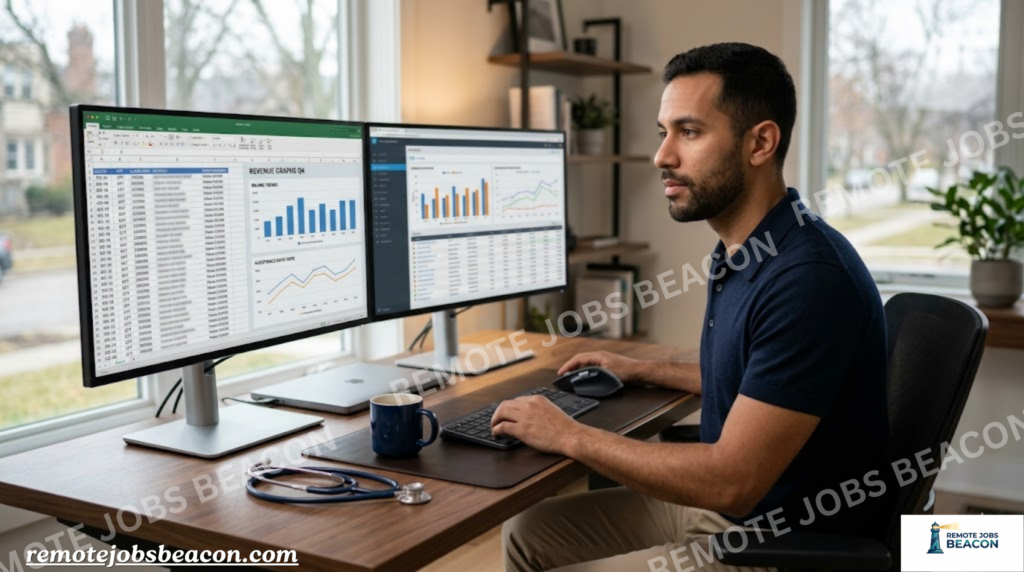
Throughout the afternoon, you manage aging accounts, process refunds for credit balances, and return communications from insurance carriers via email. The core mission of remote billing jobs is relentless follow-up. You are pursuing collections on all claims until payment is made in full. It is a highly analytical, quiet, and deeply focused workday.
Remote vs. In-Clinic Workflow Transformation
How does a traditional hospital billing role convert to a home office? The transition is entirely digital. If you want to secure the best remote billing jobs, you must prove you can manage these workflows independently.
| Traditional In-Clinic Billing Workflow | The Virtual Workflow for Remote Billing Jobs |
| Pulling physical patient charts from filing cabinets to verify doctor notes. | Accessing digital patient charts via cloud-based EHR software (Epic, Cerner). |
| Faxing paper claims and waiting on hold with insurance providers for hours. | Utilizing automated clearinghouses to submit batch claims electronically. |
| Walking to the coding department to clarify missing CPT codes. | Using integrated secure messaging within the hospital’s network to query staff. |
| Manually working through physical mail to process insurance denial letters. | Working automated, categorized digital Work Queues (WQs) for daily rejections. |
Skill Gap Analysis: What Corporate Employers Actually Demand
The physical tasks of mailing paper bills are obsolete. To land competitive remote billing jobs, your resume must highlight digital competency and a deep understanding of the revenue cycle.
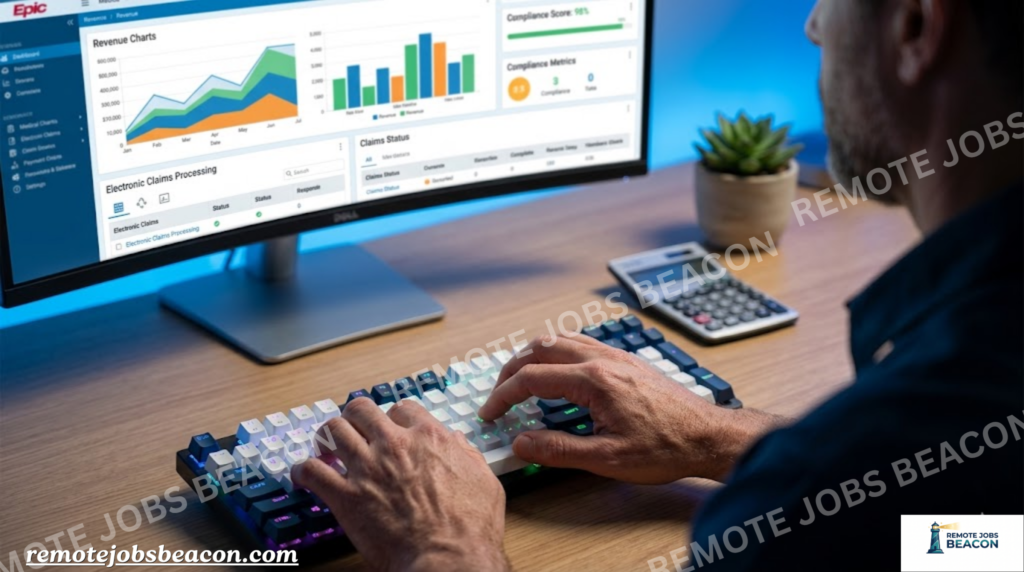
First, software proficiency is non-negotiable. Top hospitals and insurance carriers use enterprise-level systems like Epic, Cerner, or Athenahealth. You must also understand how to use clearinghouse software to scrub claims before submission.
Second, employers prioritize candidates who understand specific payer rules. Billing Medicare requires a completely different compliance protocol than billing Blue Cross. Your ability to monitor claims for missing information, authorization numbers, and correct modifiers is what makes you valuable. Hiring managers for remote billing jobs are specifically looking for professionals who can independently process rejections by identifying the root cause of the error and executing the secondary filing efficiently.
If you are unsure how your current administrative or customer service background translates to these specific software and regulatory requirements, utilize our Job Matchmaker Tool to instantly analyze your profile against active employer demands in the virtual healthcare sector.
Furthermore, corporate recruiters for remote billing jobs use automated software to filter applicants. They screen for exact phrases like “denial management,” “aging accounts,” “Work Queues (WQs),” and “electronic claims filing.” To ensure your application passes these corporate screening filters, always run your document through an ATS Resume Builder Tool before hitting submit.
Career Trajectory: A 5-Year Roadmap in Remote Revenue Cycle Management
One of the greatest advantages of remote billing jobs is the clear, highly lucrative career progression. You do not need a four-year degree to reach the senior levels of this field. According to recent surveys by the American Academy of Professional Coders (AAPC), experience and specialized certifications dictate your earning power.
Year 1: The Entry-Level Foundation
You will likely start as a Medical Billing Specialist or Patient Account Representative. Your focus will be on working standard queues, submitting clean claims, and learning the nuances of primary and secondary payer responsibilities. According to the U.S. Bureau of Labor Statistics (BLS), entry-level medical records specialists earn around $45,000 to $50,000 annually.
Years 2-3: Mid-Level Specialization
After mastering the basics, professionals in remote billing jobs often specialize. You might become a Denials Management Specialist, focusing entirely on investigating and overturning complex insurance rejections. At this stage, obtaining a certification like the Certified Professional Biller (CPB) will aggressively boost your salary into the $60,000 to $65,000 range.
Years 4-5: Senior Leadership and Auditing
By year five, your deep understanding of third-party liability and compliance allows you to step into roles like Revenue Cycle Analyst or Billing Department Manager. You will be training junior staff, auditing billing practices to ensure compliance with federal standards, and maximizing the hospital’s revenue. Senior professionals with multiple credentials in remote billing jobs frequently earn between $75,000 and $85,000+ per year.
The Certification Matrix for Career Growth
To advance rapidly in remote billing jobs, you must collect credentials. Employers pay a premium for verified expertise.
| Certification Name | Best For… | Estimated Salary Impact for Remote Billing Jobs |
| Certified Professional Biller (CPB) | Establishing baseline authority in all aspects of the medical revenue cycle. | Averages $63,000+ annually; the gold standard for billers. |
| Certified Professional Coder (CPC) | Transitioning into hybrid billing/coding roles; mastering CPT and ICD-10 codes. | Pushes salary toward $67,000+; highly demanded by corporate systems. |
| Certified Professional Compliance Officer (CPCO) | Senior-level auditors ensuring the facility meets all federal healthcare regulations. | Averages $94,000+; perfect for high-level management tracks. |
The Financial Reality of Virtual Medical Billing
The healthcare industry is actively embracing the work-from-home model. Recent data indicates that nearly 65% of medical billers and coders now operate entirely remotely. This shift means that your location no longer limits your income.
The most competitive remote billing jobs are highly stable. The U.S. population is aging, healthcare utilization is increasing, and the shift toward complex, value-based care models means that hospitals desperately need meticulous professionals to manage their cash flow. By staying updated on billing requirements and maintaining strict confidentiality of patient information, you secure a recession-proof career.
APPLY NOW
Frequently Asked Questions
Can I secure these jobs without prior healthcare experience?
Yes. Many entry-level remote billing jobs require only a high school diploma combined with a specialized certificate from a technical school. If you possess strong data entry skills and a baseline understanding of medical terminology, many large healthcare networks will train you on their specific billing software.
Do employers provide the computer equipment for virtual roles?
Yes. Legitimate hospitals and healthcare corporations will ship you a secure, company-managed laptop pre-loaded with encrypted VPNs to ensure strict adherence to HIPAA and patient privacy regulations.
Will artificial intelligence eliminate medical billing careers?
No. While AI and automation are streamlining the claims submission process, human oversight is absolutely essential. The future of remote billing jobs involves managing the exceptions, investigating complex denials, and negotiating directly with insurance carriers—tasks that require human analytical skills and diplomacy.
Do I need an active medical coding credential just to do billing?
No. Billing and coding are distinct disciplines, though they overlap heavily. You can build a highly successful career exclusively in billing and accounts receivable without ever taking a coding exam, though dual-certified professionals do command the highest salaries in the market.
Are flexible hours common in this profession?
Yes. Because you do not have to interact with patients face-to-face, many remote billing jobs offer flexible, asynchronous scheduling. As long as you complete your work within authorized timeframes, process your assigned Work Queues daily, and meet department standards, many employers allow you to set your own hours.
Landing a premium position in this sector requires treating your job hunt like a professional project. You must prove to corporate recruiters that you are organized, technologically literate, and capable of operating entirely without supervision. Upgrade your certifications, optimize your resume for automated systems, and start targeting the thousands of active remote billing jobs shaping the future of healthcare administration today.
