If you are exhausted by the physical toll of traditional clinical environments or simply want to transition your customer service skills into a booming, recession-proof sector, you are likely hunting for remote healthcare jobs. You are certainly not alone. The medical industry is undergoing a massive operational transformation. Major corporations and digital health networks have finally realized that patient support, revenue cycles, and care coordination can be handled entirely from a home office. However, finding legitimate remote healthcare jobs requires far more than just submitting a generic application online. You have to understand the highly specific virtual workflows these corporate employers demand.
Let’s look at a real-world market example to paint a clear picture. TTEC, a global leader in customer experience solutions, recently posted a California-based virtual role for a Healthcare Customer Service Representative. By analyzing this specific job data, we can decode exactly what the corporate medical sector expects from applicants today. If you want to secure the best remote healthcare jobs available right now, pay close attention to this breakdown.
A Day in the Life: The Ground Reality of Remote Healthcare Jobs
Many professionals falsely assume that remote healthcare jobs involve relaxed schedules, flexible hours, and occasional emails. The reality is far more structured and heavily metric-driven. Let’s step into the shoes of a TTEC Healthcare CSR to see what your Tuesday actually looks like.
You clock in at 8:00 AM sharp from your dedicated, distraction-free home workspace. A quiet environment is strictly mandated. Your employer requires a secure, high-speed wired internet connection boasting a minimum of 25 Mbps. Attempting to use a Wi-Fi connection from a local coffee shop will result in immediate termination, as patient privacy laws are strictly enforced.
By 8:15 AM, the calls start hitting your headset constantly. You are the frontline representative for consumers trying to understand their complex medical benefits. A stressed parent calls, completely confused about their co-pay for a recent pediatric visit. You pull up multiple Windows-based applications simultaneously. You cross-reference insurance guidelines while remaining incredibly empathetic and patient. You resolve the inquiry, document the interaction perfectly in the company’s internal system, and within thirty seconds, the next call drops in.
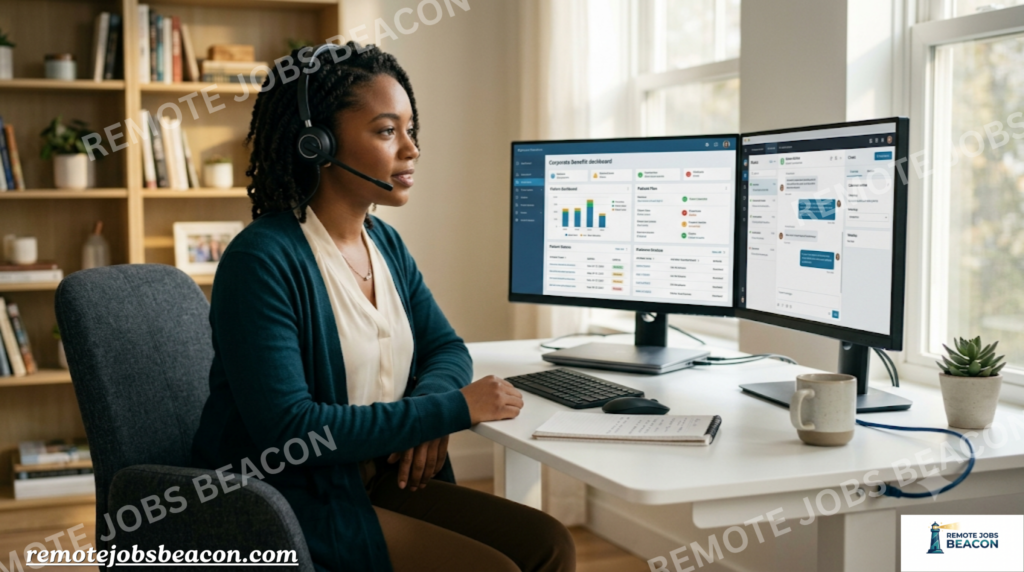
Entry-level remote healthcare jobs are incredibly fast-paced. You are answering incoming customer calls promptly, adhering to strictly scheduled break times, and participating in ongoing virtual coaching sessions. The starting wage for this specific TTEC role is $17.65 per hour. While that represents the entry-level baseline, it comes paired with a comprehensive benefits package featuring paid time off, health incentives, and tuition reimbursement. This is your proving ground. Master this high call volume, and the lucrative upper tiers of the medical industry open up for you entirely.
Comparing Workflows: Traditional Settings vs. Virtual Operations
Transitioning to virtual medical support means completely rewiring how you handle daily administrative tasks. The table below illustrates the stark differences you will face when shifting into remote healthcare jobs.
| Traditional In-Clinic Operations | Virtual Workflow for Remote Healthcare Jobs |
| Face-to-face patient de-escalation at a crowded front reception desk. | Managing high-volume caller frustration purely through voice tone and empathy over a corporate headset. |
| Walking down the hallway to ask a billing supervisor a direct question. | Utilizing internal chat software and collaborative digital tools to query team leaders instantly. |
| Pulling physical insurance binders and patient files to verify benefits. | Conducting rapid research across multiple proprietary computer systems and databases simultaneously. |
| Physical oversight by office managers ensuring you are sitting at your desk. | Strict software tracking of your system login times, average call durations, and adherence to scheduled breaks. |
Skill Gap Analysis: What Employers Actually Demand for Remote Healthcare Jobs
Let’s dissect the exact qualifications from the TTEC case study. Top employers are not looking for extensive medical degrees for these frontline positions. They are looking for highly specific soft skills and rock-solid technological competence.
First, you need a minimum of six months of standard customer service experience. Notice they do not explicitly demand a medical background for this entry-level tier. They demand strong empathy, immense patience, and extreme attentiveness. When patients call about their health benefits, they are often vulnerable or confused. Your ability to project professionalism while managing high call volumes is your absolute most valuable asset in these remote healthcare jobs.
Second, you must possess strong computer literacy. The job requires high proficiency with Windows-based applications. In more advanced roles, this evolves into requiring experience with major Electronic Health Record (EHR) systems like Epic, Athenahealth, or Cerner. If you struggle with dual monitors, toggling rapidly between browser tabs, or learning new database software on the fly, you will likely fail in this environment.
How do you know if your current background translates to the specific demands of these employers? Stop guessing. To see if your specific soft skills and software proficiencies align with active corporate openings, use our targeted [Job Matchmaker Tool]. It instantly evaluates your profile against the actual requirements of premium remote healthcare jobs, saving you dozens of hours of manual searching and frustration.
Beating the Automated Gatekeepers
If you possess the necessary empathy and tech skills, you still have to pass the initial software screen. Companies hiring for remote healthcare jobs receive thousands of applications per week. They utilize Applicant Tracking Systems (ATS) to filter out resumes that lack specific phrasing and format structures.
If your resume simply says “answered phones,” the ATS will immediately reject you. You must mirror the exact language of the job description. State that you “managed high call volumes while maintaining strict quality standards and professionalism.” Mention that you “conducted multi-system research to resolve complex customer inquiries effectively.” To guarantee your formatting is clean and your keywords perfectly match what corporate algorithms prioritize, run your document through an [ATS Resume Builder Tool] before you ever click the apply button.
Career Trajectory: Your Next 5 Years in Remote Healthcare Jobs
The absolute best aspect of securing one of these entry-level remote healthcare jobs is the massive upward mobility. The medical corporate ladder is entirely accessible from your home office. The longevity of remote healthcare jobs makes them an incredible long-term investment.
Year 1: The Frontline Foundation
You begin as a Healthcare CSR (exactly like the TTEC role). You earn roughly $35,000 to $40,000 annually. You learn the massive, complicated web of health insurance, Medicare, Medicaid, and commercial benefit structures. You prove your daily reliability and perfect your software system tracking skills.
Years 2-3: Specialization and Coordination
Once you master benefit explanations, you transition away from general inbound calls. You move into specialized roles like Patient Care Coordinator or Pre-Authorization Specialist. You coordinate directly with doctor’s offices to get specialized medical procedures approved by insurance carriers. Your salary climbs into the $45,000 to $55,000 range. The daily call volume drops significantly, and the analytical problem-solving requirement rises.
Years 4-5: Leadership and Revenue Cycle
By your fourth year, you leverage your deep understanding of the system to shift into supervisory positions or transition heavily into the Revenue Cycle Management (RCM) sector. You might become a Virtual Team Leader, coaching new CSRs, or step into a role as a Claims Analyst. Professionals who stick with remote healthcare jobs for five years and obtain industry credentials routinely push their salaries toward $65,000 to $80,000 annually.
The Certification Matrix for Virtual Growth
If your goal is to find remote healthcare jobs that pay top-tier salaries, you need to acquire verified credentials. When you start applying for remote healthcare jobs at the senior level, these certificates separate you from the competition.
| Target Certification | Best Suited For… | Career Impact in Remote Healthcare Jobs |
| Certified Healthcare Professional (CHP) | Customer Service Reps wanting to prove their foundational industry knowledge. | Demonstrates massive commitment; drastically improves chances of promotion to Team Lead. |
| Certified Medical Reimbursement Specialist (CMRS) | Individuals transitioning from customer service to billing/claims resolution. | Shifts your earning potential significantly upward by adding hard financial skills. |
| Certified Patient Experience Professional (CPXP) | Senior coordinators focusing on overall care quality and patient advocacy. | Essential for upper-level management tracks within large hospital networks. |
Frequently Asked Questions
Do I need a college degree to get hired in this field?
No. As clearly demonstrated by the TTEC corporate requirements, many entry-level virtual roles in the medical sector only require a high school diploma or equivalent, paired with just six months of basic customer service experience.
Will the company provide my computer and headset?
Yes. The vast majority of legitimate employers hiring for corporate medical roles will ship a fully configured, secure computer and headset directly to your home. You are typically only responsible for providing the high-speed wired internet connection.
Can I work these jobs using a Wi-Fi connection from a public café?
No. Due to strict HIPAA regulations and the necessity of highly stable VOIP phone systems, employers mandate a secure, private, distraction-free home office with a hardwired ethernet connection.
Are there real opportunities for advancement if I start at the bottom?
Yes. Corporate medical support features massive internal mobility. Starting as a basic phone agent gives you the exact foundational knowledge of insurance policies required to advance into highly lucrative care coordination or billing roles later in your career.
Is the starting pay always minimum wage for entry-level work?
No. While the work is entry-level, the baseline pay is often highly competitive. For example, the TTEC role starts at $17.65 per hour, which sits well above the national minimum wage, and includes comprehensive corporate benefits like tuition reimbursement and paid time off.
Final Thoughts on Your Virtual Medical Career
The transition away from physical clinics is permanent. A true career in remote healthcare jobs offers stability that few other industries can match. Massive corporate entities demand reliable, highly empathetic professionals to manage their patient populations from afar. If you want to excel in remote healthcare jobs, you must treat the application process seriously.
By understanding the specific software requirements, setting up a fully compliant home office, and tailoring your resume to beat the automated systems, you position yourself perfectly for success. Start targeting these entry-level openings today. Master the daily workflows, earn your specialized certifications, and build an incredibly stable, high-paying career. The future of the entire industry lives online, and your opportunity to secure the absolute highest paying remote healthcare jobs is sitting right in front of you. Get your home office ready, optimize your professional profile, and step into an industry where you can truly thrive in remote healthcare jobs.
