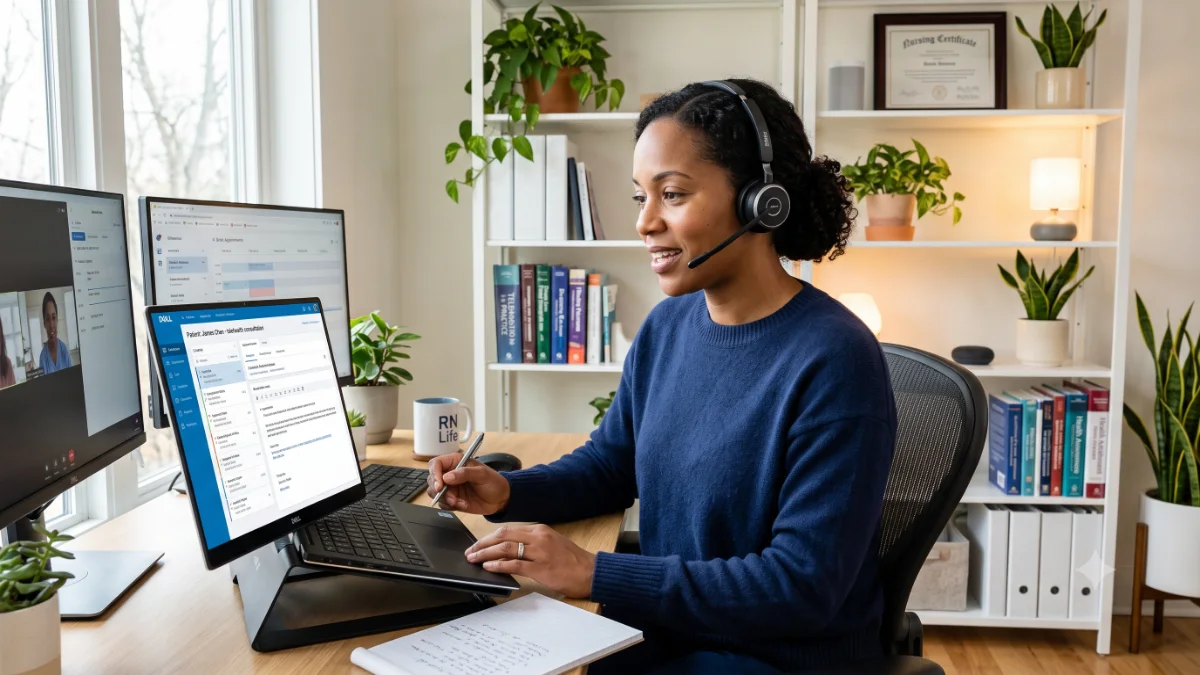
The endless 12-hour shifts. The exhaustion of being on your feet all night. The physical strain of patient lifting and the non-stop alarm fatigue of the ICU. If this sounds familiar, you are likely part of the massive wave of healthcare professionals actively looking for an exit from the physical bedside. Fortunately, health insurance companies, telehealth groups, and hospital networks are expanding their corporate work-from-home structures. If you are qualified, you can pivot your clinical experience directly into sustainable, high-paying remote registered nurse jobs without sacrificing your professional credentials.
Moving into a remote position requires a complete shift in how you present your clinical competence. Healthcare enterprises operate like corporate entities, utilizing electronic screening parameters to process thousands of license holders. If you are ready to trade your hospital scrubs for a stable home office, this detailed guide provides the exact strategic roadmap to securing top-tier remote registered nurse jobs.
Step 1: Target the Right Corporate Sub-Specialties
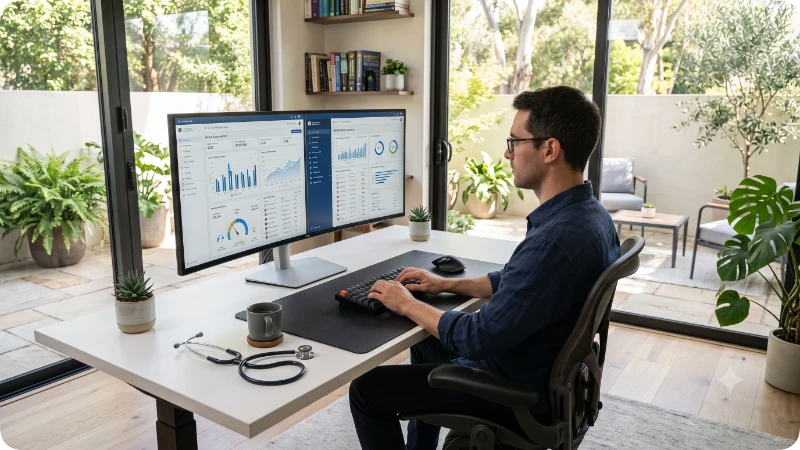
Many hospital practitioners assume that remote nursing means simply answering a phone to handle basic patient triage. In reality, the corporate healthcare sector relies on remote license holders across several specialized administrative segments. To maximize your hiring probability, you must understand exactly where your clinical background fits best.
- Utilization Review and Management: In these roles, you evaluate clinical documentation against evidence-based criteria like InterQual or Milliman Care Guidelines (MCG). You determine if a medical procedure or hospital admission meets the insurance provider’s standards for coverage. This segment offers excellent predictability and zero direct patient confrontation.
- Remote Case Management: If you enjoy coordinating long-term care plans, this role centers on helping patients manage complex chronic diseases or post-acute recovery. You act as the primary liaison between insurance networks, physicians, and families.
- Telehealth Triage and Support: Best suited for former emergency room or intensive care professionals, telehealth triage involves rapid clinical assessment via phone or video. You guide patients toward appropriate care settings based on structured symptom protocols.
- Clinical Documentation Improvement (CDI): As a CDI specialist, you review medical charts to ensure clinical specificity. Your accurate translations support appropriate facility reimbursement and quality metrics.
Step 2: Evaluate the Financial Reality of Remote Nursing
Before submitting applications, you need to look past the base salary figure to understand your true net earnings. While a corporate position might occasionally offer a slightly lower baseline hourly rate than an acute-care hospital script that includes high weekend shift differentials, the out-of-pocket savings from a home office completely alter the final calculation.
Bedside vs. Home Office Financial Comparison
The breakdown below contrasts the actual economic variables of traditional hospital employment against corporate remote registered nurse jobs.
| Economic Variable | Traditional Hospital Bedside Position | Remote Home-Office Position |
| Average Base Salary | $78,000 – $95,000 | $80,000 – $105,000 |
| Shift Differentials / OT | Available ($5,000 – $12,000 additional) | Rarely available (Flat, stable salary) |
| Annual Commuting & Fuel | $2,500 – $4,500 | $0 (Zero commute miles) |
| Parking & Toll Fees | $600 – $1,500 | $0 |
| Uniforms, Scrubs, & Shoes | $400 – $1,000 | $0 (Standard casual wear) |
| Workplace Meals & Coffee | $1,500 – $3,000 | Minimal home preparation costs |
| Physical Wear and Strain | High (Physical therapy, back issues) | Low (Desk-based, ergonomic seating) |
Step 3: Optimize Your Credentials and Secure a Compact License
Your single-state license is a major bottleneck. Corporate entities managing national patient bases favor applicants who can hit the ground running across multiple state jurisdictions simultaneously.
Before drafting your resume, check your state’s status with the Nurse Licensure Compact (NLC). If your primary state of residence participates, apply for your multi-state upgrade immediately. Having a compact designation expands your available job pool threefold. It places you at the top of the pile for national payers like UnitedHealth Group, Humana, and Centene, who need staff capable of serving members across different time zones.
Step 4: Restructure Your Resume for Corporate ATS Screening
Your clinical resume is likely structured around hands-on care tasks. Phrases like “administered IV medications,” “monitored vital signs,” or “provided direct bedside support” are standard in hospital systems. However, corporate automated tracking systems screen for business and compliance keywords. To win remote registered nurse jobs, you must translate your daily clinical activities into corporate metrics.
Translating Clinical Tasks to Business Assets
The table below demonstrates how to transform standard clinical summaries into high-performance, metrics-focused bullet points built to clear corporate automated filters.
| Traditional Bedside Description | Corporate/ATS Translation for Remote Roles |
| “Responsible for taking care of 5-6 acute stroke patients per twelve-hour shift.” | “Managed high-volume acute caseloads; coordinated interdisciplinary discharge plans for up to six complex patients daily.” |
| “Charted completely in Epic and helped train new staff on our unit’s software.” | “Served as an Epic EHR system superuser; trained 15+ incoming clinical personnel on documentation compliance and system protocols.” |
| “Checked chart notes to make sure the doctor’s orders were written correctly.” | “Audited medical charts for clinical accuracy, ensuring 100% alignment with regulatory standards and billing guidelines.” |
| “Talked to families on the phone and gave updates after patient procedures.” | “Executed professional telephonic case communication; managed complex stakeholder updates across diverse demographics.” |
To ensure your document layout and text vocabulary match exactly what corporate recruiters expect to see, passing your current draft through a specialized ATS Resume Builder Tool can highlight precise gaps before you apply.
The Strategic Sequence to Transitioning from Bedside to Remote Roles
Landing a remote role requires a calculated process. Follow this chronological execution sequence to move your license out of the hospital wards and into a dedicated corporate position.
1.Acquire Core Software Familiarity:Week 1.
Do not just claim computer literacy. Actively learn the software standards governing remote healthcare. Familiarize yourself with basic corporate suites like Microsoft Teams, Excel, and Sharepoint. If you have any exposure to clinical review criteria like InterQual or Milliman Care Guidelines (MCG), elevate this knowledge block directly to the top of your skills layout.
2.Execute the Resume Transformation:Week 2.
Strip all non-essential bedside text out of your profile. Focus your work experience entirely on your documentation accuracy, your adherence to compliance metrics, and your independent decision-making capabilities. Highlight any past experience where you worked in remote telephonic follow-ups, telephone triage, or home health coordination.
3.Target Enterprise Payer Networks:Weeks 3-4.
Instead of browsing generic regional job aggregates, go straight to the primary employers of remote clinical staff. Build applicant profiles directly inside the career portals of major national managed care organizations, insurance entities, and third-party administrators.
4.Deploy Optimized Applications Daily:Weeks 5-6.
Submit 10 to 15 targeted applications every single week. Focus explicitly on entry-level utilization review positions, remote prior authorization nurse titles, or seasonal HEDIS auditing opportunities. Keep a clear tracking spreadsheet noting the job title, application date, and specific corporate tracking platform used.
Step 5: Ace the Corporate Virtual Interview
The interview loop for corporate medical jobs is entirely distinct from a casual peer interview on a hospital floor. You will face a structured screen with human resources, followed by an intensive panel interview with clinical directors. They will use behavioral assessment methodologies to ensure you can function without hands-on supervision.
Preparing Your Physical and Verbal Space
Because the role is entirely work-from-home, your virtual interview serves as your first practical test. Set up in a quiet room with solid lighting and a clean, neutral background. Use a dedicated headset to eliminate echo. This proves to the panel that you possess the appropriate physical environment to handle private, HIPAA-compliant patient conversations.
Answering Behavioral Questions
Expect questions built around the STAR method (Situation, Task, Action, Result). Prepare specific stories from your hospital experience that prove your metric optimization, communication clarity, or conflict management:
HR Director Interview Secret: When asked why you want to leave the bedside, never complain about burnout, bad management, or understaffing. Corporate hiring panels see that as a red flag. Instead, pivot to professional expansion: “I have built a foundational clinical base across five years in acute care. I am now looking to apply that system expertise at scale to optimize utilization review metrics, improve documentation fidelity, and drive cost-effective patient outcomes.”
To identify the enterprise insurance networks and managed care platforms currently looking for your specific clinical background, use our dedicated Job Matchmaker Tool to connect your license details with live corporate postings.
Finding a path away from physical exhaustion does not require you to leave the profession you worked so hard to enter. By modernizing your resume, targeting the right administrative segments, and showcasing your clinical expertise as a business asset, you can successfully secure stable, long-term remote registered nurse jobs.
Frequently Asked Questions
Do remote registered nurse jobs require an advanced degree like a BSN or MSN?
No. While holding a Bachelor of Science in Nursing (BSN) makes your profile highly competitive for management tracks, many managed care organizations actively hire Associate Degree in Nursing (ADN) holders who possess extensive, recent acute-care clinical experience.
Can a newly graduated nurse land a fully remote position immediately?
No. The vast majority of corporate employers require a minimum of two to three years of solid, independent bedside experience in an acute setting like med-surg, ER, or ICU to ensure you have the clinical judgment necessary to make unassisted chart determinations.
Is a multi-state compact nursing license required before applying to corporate roles?
Yes. While it is not always a hard legal rule for every local company, possessing an active multi-state compact license makes you infinitely more employable to major national health systems that manage member bases across several states.
Do remote insurance review nurses have to work standard night and weekend shifts?
No. One of the single greatest advantages of moving into utilization management or prior authorization segments is transitioning to a predictable corporate schedule, typically consisting of standard Monday through Friday daytime business hours.
