You are exhausted from scrolling through endless job boards. I completely get it. Finding legitimate remote call center jobs right now feels like searching for a needle in a massive digital haystack. But here is the raw truth from someone who has spent the last two decades running HR departments for major U.S. corporations: these roles are heavily abundant. You just aren’t applying for them correctly.
The competition is fierce. Everyone wants the flexibility of working from their living room, skipping the morning commute, and managing customer inquiries in sweatpants. However, securing one of these highly coveted positions requires strategy. You cannot simply blast out a generic resume and pray for a callback. Hiring managers are overwhelmed with applications, so you must stand out instantly.
Let’s tear down the old rulebook. Instead of a boring, textbook overview, we are going to dive straight into the most pressing questions you have. We will break down exactly where to look, how to bypass the automated screening software, what you should be getting paid, and how to dominate your virtual interview.
Q: Are Remote Call Center Jobs Actually Disappearing in 2026?
Let me stop you right there. Absolutely not.
While you might read terrifying headlines about companies forcing employees back to physical cubicles, the customer support sector plays by an entirely different set of rules. Maintaining massive, physical call centers is incredibly expensive. Smart executives realized years ago that allowing agents to work from home slashes overhead costs dramatically. Rent, utilities, and commercial insurance bills disappear.
What has changed is the expectation of the worker. Employers are no longer desperate bodies to fill seats like they were a few years ago. The remote work market has stabilized. Today, hiring managers want polished professionals who possess serious technical adaptability. They want problem-solvers. They want independent thinkers who do not need a supervisor hovering over their shoulder to maintain high customer satisfaction scores.
If you bring a high level of professionalism, excellent communication skills, and a reliable internet connection, the market for remote call center jobs remains incredibly robust. You just have to know how to position yourself as a top-tier candidate rather than a risky remote hire.
Q: What Exactly Do You Need to Make 100% Remote Work, Work?
Do not even think about applying until your home office is locked down. I have disqualified hundreds of candidates simply because their background noise was too high during the phone screen, or their internet cut out while we were talking.
When you apply for remote call center jobs, you are essentially promising the company that your house is a professional environment. Here is the non-negotiable tech stack and physical setup you need:
- Hardwired High-Speed Internet: Wi-Fi is great for watching Netflix. It is terrible for Voice over Internet Protocol (VoIP) software. You need an Ethernet cable plugged directly into your router. Most reputable companies require minimum download speeds of 25 Mbps and upload speeds of 10 Mbps.
- A Dedicated, Door-Closing Workspace: Working from the kitchen table while your dog barks at the mailman will get you fired. You need a room with a door. Silence is your most valuable asset.
- A High-Quality USB Headset: Forget your Bluetooth earbuds. You need a wired USB headset with active noise cancellation on the microphone. Jabra and Plantronics are industry standards.
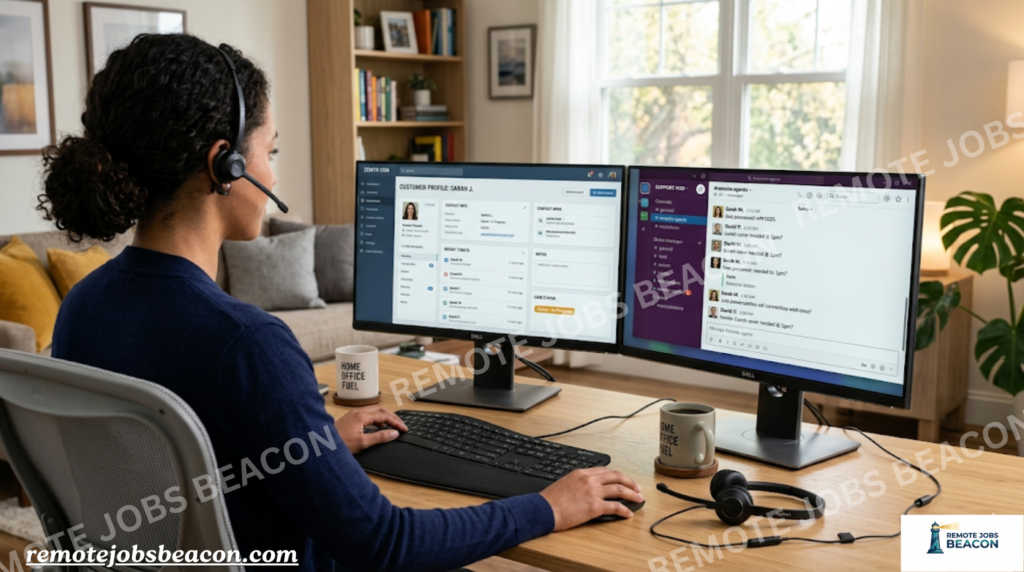
- Modern Computing Power: While elite companies often ship you a pre-configured laptop, many staffing agencies and smaller businesses require a “Bring Your Own Device” (BYOD) setup. Ensure you have a PC or Mac with at least 8GB of RAM, a modern processor, and dual monitors. Dual monitors are life-changing when you are juggling a CRM, a chat window, and an internal knowledge base simultaneously.
Q: Where Are the Best Remote Call Center Jobs Hiding Right Now?
Stop limiting your search to the generic “Easy Apply” buttons on massive job boards. Those listings attract tens of thousands of applicants within hours. Your application simply gets buried at the bottom of the digital pile.
To find the best remote call center jobs, you need to go directly to the source. Look at Business Process Outsourcing (BPO) companies that specialize in remote customer experience. Look at major tech startups. Look at healthcare providers expanding their telehealth support networks.
Here are the specific sectors and platforms you should be targeting:
- Specialty Remote Job Boards: Sites that heavily vet their listings for work-from-home authenticity.
- The Healthcare Sector: Companies like UnitedHealth Group, CVS Health, and Humana are constantly hiring remote customer service representatives to handle patient scheduling, insurance verification, and billing inquiries.
- E-commerce & SaaS: Shopify, Stripe, and large e-commerce management agencies like TalentPop are aggressively hiring remote support talent to assist their global merchant base.
- Financial Services: American Express and Capital One are famous for their massive, well-compensated remote call center teams.
When searching, use specific queries. Instead of just searching the primary keyword, look for “Inbound Support Specialist remote,” “Customer Success remote,” or “Virtual Call Center Agent.”
Q: How Do I Build a Resume That Beats the ATS Every Single Time?
This is the most essential part of your job hunt. Applicant Tracking Systems (ATS) are the gatekeepers. If your resume does not contain the right keywords formatted in the right way, a human being will never even see your name.
You must tailor your resume for the exact remote call center jobs you want. This means proving you can handle customer de-escalation, master multiple software platforms, and maintain strict attendance from home.
Here is a blunt reality check: listing “answered phones” as your main duty is a fast track to the rejection pile. You need metrics. You need software names. You need action verbs. If you want to bypass the headache of formatting this manually, utilizing a dedicated ATS Resume Builder Tool can instantly format your experience to match what these bots are scanning for.
Let’s look at a clear comparison of how to structure your bullet points.
Resume Impact Comparison: The Weak vs. The ATS-Optimized
| Resume Component | The Weak, Generic Approach (Will be Rejected) | The Elite, ATS-Optimized Approach (Gets Interviews) |
| Professional Summary | “Hardworking customer service rep looking for remote call center jobs to help people.” | “Bilingual Customer Support Specialist with 4 years of remote experience. Proven track record of maintaining a 96% CSAT score while managing high-volume omnichannel support (Voice, Email, Chat).” |
| Experience Bullet 1 | “Answered customer phone calls and fixed their problems.” | “Resolved an average of 65+ inbound technical support tickets daily, consistently achieving First Call Resolution (FCR) rates 15% above the company average.” |
| Experience Bullet 2 | “Used computer systems to look up accounts.” | “Navigated Salesforce and Zendesk simultaneously to update customer billing information securely while adhering to strict compliance protocols.” |
| Experience Bullet 3 | “Worked well from home without a boss.” | “Maintained 99.8% schedule adherence in a 100% remote, unsupervised environment, utilizing Slack and Microsoft Teams for cross-departmental collaboration.” |
| Technical Skills Section | “Good at typing, Microsoft Word, Internet.” | “Zendesk, Five9, Salesforce Service Cloud, Gorgias, VoIP Troubleshooting, WPM: 75.” |
If your resume looks like the middle column, fix it today. Stop being vague. Tell the hiring manager exactly how many calls you took, what software you used to take them, and how happy the customers were afterward.
Q: What Should My Salary Expectations Be in 2026?
Do not accept minimum wage. The market has shifted, and remote customer experience professionals are recognized as the frontline face of the brand. Compensation has finally started to reflect that reality.
Pay for remote call center jobs varies wildly based on three factors: the industry, your technical knowledge, and your geographic location (even for remote roles, companies often base pay on your state of residence due to labor laws).
Here is what the data from the U.S. Bureau of Labor Statistics and current market trends indicate for 2026:
2026 Remote Call Center Jobs Salary Expectations
| Role / Level | Required Experience | Expected Hourly Rate (USD) | Bonus / Commission Potential |
| Tier 1 Customer Support (Retail/Basic Info) | 0 – 1 Year | $16.00 – $19.00 / hour | Minimal (Occasional performance stipends) |
| B2B Inside Sales / SDR | 1 – 3 Years | $20.00 – $25.00 / hour | High (Uncapped commission structures common) |
| Tier 2 Technical Support | 2 – 4 Years | $22.00 – $28.00 / hour | Moderate (Quarterly bonuses based on CSAT/AHT) |
| Healthcare / Licensed Insurance Agent | Licensing Required | $24.00 – $32.00 / hour | High (Sign-on bonuses and policy commissions) |
| Remote Call Center Team Lead | 4+ Years | $65,000 – $85,000 / salary | Moderate (Annual performance bonuses) |
If you are bilingual (especially Spanish-English in the U.S. market), expect to add a premium of $1.50 to $3.00 per hour to these base rates. Bilingual agents are in massive demand across every sector. To find out exactly which compensation bracket you fit into based on your background, running your profile through a Job Matchmaker Tool can instantly align your experience with the highest-paying roles currently available.
Q: How Do I Crush the Virtual Interview for Remote Call Center Jobs?
You got the interview. Congratulations. Now, you need to prove you are not a remote-work liability.
Virtual interviews are highly specific. The recruiter is not just listening to your answers; they are analyzing your environment. They are checking to see if your camera is at eye level. They are listening for background echoes. They are watching to see if your internet lags when you speak.
You must treat the Zoom or Microsoft Teams interview exactly like an in-person meeting. Dress professionally from the waist up. Ensure your background is blurred or entirely neutral.
Be prepared for behavioral questions. The STAR method (Situation, Task, Action, Result) is your best friend. When they ask, “Tell me about a time you dealt with an angry customer,” they do not want a vague story.
They want specifics.
- Situation: “A customer called in furious because their software subscription auto-renewed.”
- Task: “I needed to de-escalate the situation, retain the customer, and follow our refund policy.”
- Action: “I actively listened without interrupting, validated their frustration, and offered a 50% courtesy credit toward the next year rather than a flat cancellation.”
- Result: “The customer accepted the credit, downgraded their anger, and left a 5-star review on my post-call survey.”
Boom. Hired.
You also need to heavily emphasize your self-reliance. Hiring managers fear remote workers who will constantly ping them on Slack for basic questions. Reassure them by stating, “I am highly resourceful. If I hit a roadblock, I consult the internal knowledge base and review previous support tickets before escalating the issue to a supervisor.” That sentence alone is absolute music to an HR director’s ears.
Securing Your Remote Future
Finding legitimate, high-paying remote call center jobs does not require a miracle. It requires a modern approach. You must treat your job hunt like a marketing campaign where you are the product. Upgrade your home office hardware, ruthlessly edit your resume for ATS compliance, target specific high-growth industries like healthcare and tech, and master the art of the virtual interview. The opportunities are vast, the pay is climbing, and the flexibility is life-changing. Take these strategies, apply them aggressively, and go claim the exact remote call center jobs you deserve.
Frequently Asked Questions
Q: Do I need a college degree to get hired for remote call center jobs?
No. The vast majority of remote call center jobs only require a high school diploma or equivalent. Hiring managers prioritize soft skills, software proficiency, and relevant customer service experience over formal higher education.
Q: Will the company pay for my internet and home office equipment?
Yes. Many top-tier U.S. employers will ship you a computer, monitors, and a headset, while also offering a monthly stipend (usually $30 to $50) to offset your internet bill. However, smaller agencies or independent contractor roles will expect you to provide your own equipment.
Q: Can I work from anywhere in the world if the job is listed as remote?
No. Due to strict tax regulations, labor laws, and data security compliance, most U.S.-based remote jobs require you to physically reside within the United States. Many will even restrict hiring to specific approved states.
Q: Is it possible to find part-time remote call center jobs?
Yes. There is a massive market for part-time, weekend, or evening shift agents, especially in industries that offer 24/7 support like travel, hospitality, and emergency dispatch services.
Q: Are there remote call center roles that do not require me to talk on the phone?
Yes. While traditional voice roles are most common, there is a rapid rise in omnichannel support. You can specifically apply for “Chat Support Specialist” or “Email Support Agent” roles where 100% of your customer interactions are text-based.
