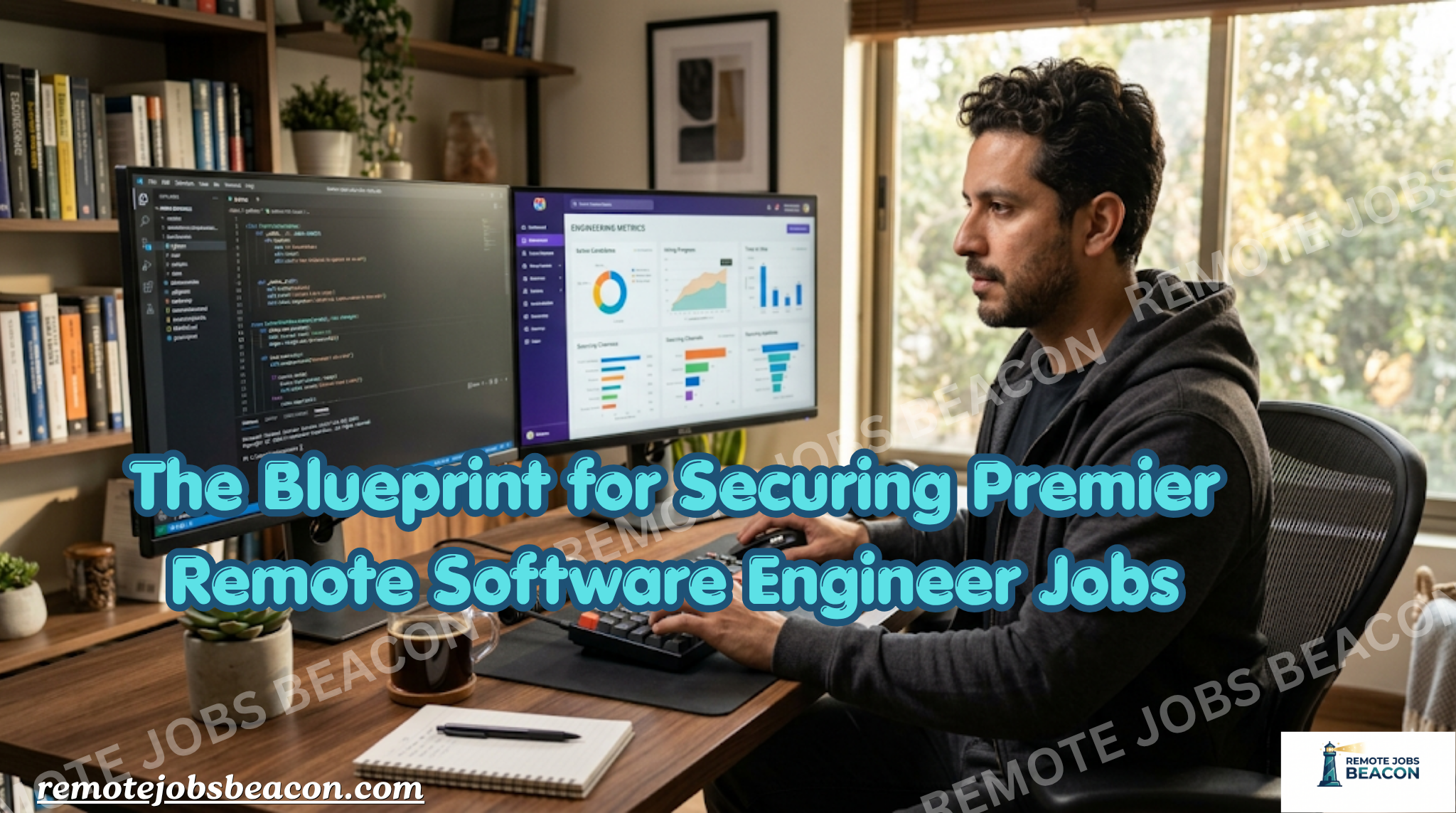
It is 8:52 AM on a Tuesday. Alex, a senior full-stack developer based in Nashville, sips his second cup of coffee while his mechanical keyboard clacks rhythmically. He isn’t rushing through a subway station, nor is he stuck in bumper-to-bumper traffic on I-40. His commute was ten seconds—from the kitchen to his dedicated home office corner. A slack notification pops up; his team in San Francisco is initiating a deploy. Alex triggers the pipeline from his terminal, reviews a pull request, and prepares for the 11:00 AM EST stand-up. This isn’t a temporary arrangement; it’s his permanent professional reality. For developers actively applying for work right now, this reality is highly accessible, provided you know where to look and how to sell yourself. The market for remote software engineer jobs has matured, shifting from an emergency experiment to a strategic talent acquisition standard.
If you are currently scouring job boards, you know the competition is fierce. Thousands of applicants are clicking “Easy Apply” on LinkedIn. The hiring managers I talk to are drowning in resumes. To land the premier remote software engineer jobs—the ones with competitive Bay Area salaries, equity, full benefits, and actual asynchronous workflows—you cannot act like an average applicant. You need an HR director’s insider perspective on beating the system. The intent of this guide is commercial and immediate; you are here because you want to apply for and land a job right now. Forget the fluff. We are going to cover exactly where these jobs are hiding, how to make your resume undeniable to automated systems, how to crush the technical and behavioral virtual interviews, and exactly what kind of money you should be demanding.
Navigating the Hiding Places: Where the Real Job Listings Are
Forget the generic mass aggregators for a second. If you want high-quality remote software engineer jobs, you need to go where the remote-first companies and specialized recruiters hang out. While LinkedIn has its place (which we will discuss shortly), the noisy environment often hides the best opportunities. Thousands of companies are hiring, but they are often using specialized channels to filter for candidates who specifically understand remote work culture.
As a seasoned talent strategist, I advise candidates to prioritize their search efforts based on the likelihood of finding vetted, high-quality listings. Don’t waste dozens of hours wading through scams or hybrid roles mislabeled as fully remote.
The Specialized Remote Job Boards
Start with platforms that have a strict vetting process for employers.
- Hacker News (“Who is Hiring”): On the first weekday of every month, Y Combinator posts this thread. It is a goldmine for remote software engineer jobs at venture-backed startups. It requires manual reading, which filters out 90% of lazy applicants.
- FlexJobs: This is a paid service, but they manually vet every single listing. It is the single best way to avoid scams and find legitimate corporate remote software engineer jobs at major non-tech enterprises shifting to virtual work.
- Wellfound (formerly AngelList): This is the hub for startup roles. It explicitly allows you to filter by “deep remote” and shows you salary ranges and equity upside upfront.
- We Work Remotely: One of the oldest and most trusted dedicated remote boards. It’s excellent for finding roles at established remote companies like Basecamp, Doist, or GitLab.

Mastering LinkedIn for Remote Roles
LinkedIn is unavoidable, but most developers use it wrong. To successfully hunt for remote software engineer jobs here, you need to be surgical.
First, your headline must be optimized. Don’t just put “Software Engineer.” Put your stack and “Remote.” For example: “Senior React/Node.js Engineer | Open to Remote.” This allows corporate recruiters searching for specifically virtual talent to find you.
Second, when using the search filter, select “Remote” in the location field and type “Remote” as a keyword in the search bar. This double-filtering helps screen out hybrid roles. More importantly, turn on job alerts for specific companies known for their remote cultures. Companies like Automattic, GitLab, Elastic, and HubSpot are often hiring, but their listings get thousands of applicants within hours. You need to be in the first wave of applications.
Skipping the Boards Entirely
A substantial percentage of premier remote software engineer jobs are never listed publicly. They are filled via internal referrals or targeted recruiter headhunting.
Find recruiters who specialize only in software engineering and connect with them. Look for agencies with a national footprint rather than local boutique firms. Agencies like Robert Half, Kelly Services, or tech-specific firms often have exclusive contracts with massive enterprises to fill confidential remote roles. Tell them explicitly you are only looking for remote software engineer jobs. They want to place you; they only get paid if you get hired. Make them do the heavy lifting for you.
To instantly match your unique stack and experience level with vetted, actively hiring employers bypassing traditional boards, leveraging our Job Matchmaker Tool can save you hundreds of hours of manual searching.
Beating the Robots: Tailoring Your Resume for a Virtual Screen
Here is the brutal truth from the HR perspective: 75% of resumes for remote software engineer jobs are rejected by software before a human eye ever sees them. This software is the Applicant Tracking System (ATS). If your resume isn’t optimized for automated parsing, you are invisible.
The most vital evidence you must present is clinical, metric-based proof of impact. The generic duties listed in your last job description do not matter. Corporate recruiters hiring for software engineering roles care about three things: scale, complexity, and business impact. When writing your resume for remote software engineer jobs in 2026, you must translate your duties into quantifiable achievements.
If you don’t know where your current resume stands against modern ATS algorithms, utilizing our ATS Resume Builder Tool is essential evidence you can’t afford to ignore if you are actively applying for work today.
The Anatomy of an Unbeatable Developer Resume
First, the formatting must be simple. Do not use two-column layouts. Do not use graphics, icons, or text boxes. Use a clean, single-column Microsoft Word doc or standard PDF. Use standard fonts like Arial or Calibri. Why? Because complex formatting breaks the ATS parser, causing your resume to look like gibberish to the system, resulting in immediate rejection.
Second, the keywords matter. Look at the job description. If it asks for “distributed systems,” “event-driven architecture,” and “Golang,” those exact phrases must appear in your resume. Do not say “microservices” if they asked for “distributed systems.” Automated systems look for direct character matching.
Quantification: The Language of the Business
Recruiters for premier remote software engineer jobs don’t just want to know what you did; they need to know how well you did it. Look at the difference between an average resume bullet and an elite one.
The Week Bedside Resume (Auto-Rejected): “Took care of patients on a busy Med-Surg floor. Charted in Epic. Talked to doctors.”
The Corporate ATS Resume (Hired): “Managed 6-patient load, maintaining 100% medication administration accuracy. Reduced average patient discharge time by 12% through optimization of Epic charting workflows.”
This is the exact same logic required for engineering resumes.
| Bedside Engineering Bullet (Rejected) | Corporate ATS Optimized Engineering Bullet (Hired) | Why it Wins |
| “Wrote React components and fixed bugs.” | “Developed reusable React component library, reducing frontend development time by 30% across three product teams.” | Quantifies time savings. Proves impact beyond immediate tasks. Includes key software keywords. |
| “Managed AWS infrastructure.” | “Architected Terraform scripts to automate AWS infrastructure deployment, decreasing deployment time from 45 minutes to 8 minutes.” | Shows direct reduction in friction. Highlights infrastructure-as-code expertise. Uses strong action verbs. |
| “Used SQL to optimize database queries.” | “Optimized complex SQL queries using indexing and caching strategies, improving database response time by 45% during peak traffic.” | Proves technical depth. Connects technical work to critical user-facing metrics (response time). Essential for remote roles managing scale. |
To make it into the top 10% of applicants for remote software engineer jobs, your resume must feature at least three of these quantified bullets per role. Prove your worth before they even meet you.

Crushing the Virtual Gauntlet: The Interview Process
The interview process for remote software engineer jobs is uniquely grueling. You aren’t just being tested on your coding ability; you are being rigorously evaluated on your ability to operate autonomously without a manager looking over your shoulder.
The Technical Assessment
It starts with the code screen. This might be a HackerRank or LeetCode timed challenge. The vital evidence you must present here is problem-solving speed and accuracy.
Next comes the pairing session. You will be on a video call sharing your screen with one or two senior engineers. Do not code in silence. Hiring managers for premier remote software engineer jobs value communication and collaboration over sheer speed. We need to know that you can articulate your thought process when you are stuck. Explain your trade-offs. Why did you choose an array over a hash map here? If you make a mistake, acknowledge it, explain why it was a mistake, and correct it. Show me your critical thinking. That is how you win the best remote software engineer jobs over hundreds of other applicants.
Finally, for senior roles, expect a System Design interview. You will be asked to “design Netflix” or “build a URL shortener.” I am looking for your understanding of scale, tradeoffs, bottlenecks, and component interaction. This is where your foundational knowledge pays off.
Acing the Behavioral (Culture-Fit) Interview
The biggest risk in hiring a remote employee is that they vanish. The “bedside manner” matters in code. In a corporate environment, I’m testing for three key behavioral traits during the virtual hiring process:
- Written Communication: A huge amount of virtual work happens in Slack and Jira. Can you explain a complex bug in writing clearly and concisely?
- Autonomy: Can you manage your own time zone and priorities without direct supervision?
- Conflict Resolution: When two engineers disagree on an architecture implementation, how do you resolve it virtually without the conversation devolving into a Slack flame war?
I always ask candidates: “Tell me about a time you had a strong technical disagreement with a colleague. How did you handle it?”
I do not just want to hear that you were right. I want to hear your analytical process and diplomacy. Tell me how you utilized evidence-based criteria or performance metrics to back up your assessment. Tell me how you communicated respectfully but firmly. Show me your leadership. That is how you win premium remote software engineer jobs over applicants who might be slightly stronger coders but weaker collaborators.
The Ultimate Filter: Salary Expectations and Location Strategy
The single biggest factor dictating your salary potential for remote software engineer jobs is not your experience; it is your location strategy.
Many national corporations are shifting to national salary bands or “localized pay.” This means if you live in New York City, your pay is $200k. If you move to Idaho, they cut your pay to $160k for the exact same job.
However, premier virtual-first companies do not care where you live within the United States. They pay “Tier 1” rates regardless. This is the financial sweet spot. You must target these companies specifically. Landing one of these roles while living in a low-cost-of-living state is the modern financial equivalent of the gold rush.
The 2026 Remote Software Engineer Salary Breakdown
Based on current U.S. market data, here is what you should expect to be paid for premium remote software engineer jobs in 2026.
| Experience Level | Sample Titles | Base Salary Range (Vetted Remote-First) | Essential Technology Stack (Examples) |
| Entry-Level | Junior Full-Stack Developer, Associate QA Engineer | $90,000 – $135,000 | JavaScript/TypeScript (React/Node.js), Basic AWS/Cloud (S3, Lambda), SQL, Git |
| Mid-Level | Software Engineer II, Cloud Infrastructure Engineer | $145,000 – $195,000 | Advanced Python (Django/Flask), Go, Java (Spring Boot), Kubernetes, Terraform, Event-Driven Architecture |
| Senior | Senior Full-Stack Engineer, Site Reliability Engineer (SRE) | $190,000 – $260,000+ | Large-scale Distributed Systems, Performance Optimization, Database Internals, System Design, Leadership experience |
| Staff/Principal | Principal Engineer, Software Architect | $240,000 – $320,000++ | Company-wide Technical Strategy, Defining Architecture Standards, Managing Technical Debt, Mentoring Senior Engineers |
Do not work for pennies just because you want to work from home. Remote work is the standard; high compensation is the new requirement. Always negotiate your starting pay. When asked about your salary expectations during virtual interviews for remote software engineer jobs, flip the question back to the corporate recruiter. “Based on the specific operational responsibilities of this engineering role and the required on-call metrics, what is the approved budget range for this position?” Let them say the baseline number first.
If they offer $180,000, and you know the market rate for a Senior SRE with your specific Kubernetes certifications is $220,000, push back professionally. Highlight your advanced cloud proficiency or your flawless record of maintaining high uptime for distributed systems as leverage.
The virtual software market is incredibly tough right now, but it is entirely manageable if you stop acting like a tired applicant and start acting like a specialized clinical professional in code. Corporations are bleeding money due to bad data, rejected claims, and inefficient care coordination. They need sharp, highly focused individuals to clean up the mess and manage complex distributed systems effectively. Stop applying blindly to massive boards. Optimize your resume for corporate algorithms. Secure your home network. Prepare your home office for the interview.
If you put these advanced strategies into play, landing highly competitive remote software engineer jobs isn’t just a distant possibility; it becomes an inevitable mathematical outcome. Close the massive job boards, refine your ATS strategy, and get to work building a career that offers both massive financial stability and total personal freedom.

1 thought on “The Blueprint for Securing Premier Remote Software Engineer Jobs”